
The 4 D's of Getting Your Home Ready to List
Thinking about listing your Atlanta home in the next few months? Learn the 4 D's Team Stafford & Rebecca walk every seller through before hitting the market: Declutter, Depersonalize, Deep Clean, and Don't Ignore Deferred Maintenance.
If you're reading this, there's a decent chance you're not quite ready to call an agent yet, but you're circling the idea. Maybe you're picturing a "For Sale" sign in the yard sometime in the next 90 days. Maybe you've already started opening closets you haven't touched in years and wondering where to even begin.
That in between stage, where you know you want to sell but haven't started prepping, is exactly where we spend most of our time with sellers. It's also the stage where the right plan saves you the most money and the most stress. At Team Stafford & Rebecca, we've walked hundreds of Atlanta homeowners through this exact process, and it almost always comes down to the same four things. We call them the 4 D's: Declutter, Depersonalize, Deep Clean, and Don't Ignore Deferred Maintenance.
None of these require a full renovation. What they require is a plan and someone who can tell you honestly where to spend your time and money, and where not to.
Declutter
Buyers aren't just looking at your home, they're trying to imagine their life inside it. A room full of furniture, papers, and everyday clutter makes that harder. It also makes the space look smaller than it is, which affects how buyers value it before they've even seen the square footage.
You don't need to empty the house. You need to edit it.
Clear countertops in the kitchen and bathrooms down to a few intentional items
Remove at least one piece of furniture from any room that feels tight or crowded
Box up out of season clothing, extra linens, and anything you haven't used in the last year
Clear closets to roughly half full so they photograph and show as storage, not overflow
A good rule: if you're on the fence about whether something needs to go, it needs to go, at least for now. You can always bring it back after closing.
Depersonalize
This one surprises people, because it feels counterintuitive. Your home is full of photos, memorabilia, and personal touches because it's your home. But a buyer walking through needs to picture their own family there, not yours.
Family photos, personal collections, and strongly personal decor can make it harder for a buyer to mentally move in. This isn't about erasing your personality from the house. It's about creating a space that reads as a home rather than as someone else's home.
Pack away family photos and personal memorabilia before your first showing
Tone down highly specific decor choices, like sports team shrines or very bold paint colors, in favor of something more neutral
Keep a few warm, lived in touches, like fresh flowers or a well placed throw blanket, so the home still feels inviting rather than sterile
Deep Clean
This is the one people underestimate the most. A home that's tidy but not deeply clean still sends a signal to buyers, and it's usually the wrong one. Grimy grout, dusty baseboards, and a hazy oven door read as neglect, even if the home has been genuinely well cared for.
A professional deep clean before listing photos are taken is one of the highest return, lowest cost things you can do.
Have carpets professionally cleaned, especially in high traffic areas
Clean windows inside and out so natural light photographs well
Pay attention to the details buyers notice up close: baseboards, light switch plates, ceiling fans, and grout
Don't skip the garage, basement, or laundry room. Buyers open those doors too
Don't Ignore Deferred Maintenance
This is the D that costs sellers the most when it's skipped. Deferred maintenance means the small repairs that got pushed off: a dripping faucet, a cracked light fixture, a door that sticks, a stain on the ceiling from a leak that was fixed years ago but never repainted.
Buyers, and their inspectors, notice these things. A house with several small, visible issues can make a buyer wonder what else hasn't been maintained, even when the answer is nothing. That doubt often shows up later as a lower offer or a long list of repair requests after inspection.
Walk through your home room by room and make a list of anything that's broken, sticking, leaking, or stained
Prioritize items that are cheap to fix but highly visible: leaky faucets, burnt out bulbs, loose cabinet hardware, scuffed paint
Get ahead of bigger ticket items, like an aging water heater or a roof nearing the end of its life, so they don't become a surprise during a buyer's inspection
When in doubt, ask us. Not every repair is worth making before you list, and we'll tell you honestly which ones matter and which ones don't
How much time does this actually take
Most Atlanta sellers we work with start this process somewhere between 60 and 90 days before they want to list, which is exactly why we're glad you're thinking about it now rather than the week before you want a sign in the yard. Some homes need far less time. Others, especially ones with deferred maintenance that's been building for a while, benefit from starting earlier. The honest answer is that it depends on your home, and that's exactly the kind of thing worth a conversation before you start any of it.
Frequently asked questions
What should I fix before listing my house? Focus on anything visible, unsafe, or likely to be flagged by a buyer's inspector: leaks, electrical issues, and anything affecting the roof, HVAC, or foundation. Cosmetic fixes like paint and fixture updates are usually worth doing. Larger renovations often aren't worth the investment right before a sale. The right answer depends on your home and your market, which is why we walk every seller through this individually.
How long does it take to get a house ready to sell? It depends on the home's condition, but most sellers benefit from 60 to 90 days of lead time. A home in strong condition might need only a few weeks. One with deferred maintenance or a lot to declutter may need longer.
Do I need to repaint before I sell? Not always, but a fresh coat of neutral paint in high traffic rooms is one of the more affordable ways to make a home feel newer and larger in photos and in person.
Is it worth getting a pre listing inspection? For many Atlanta sellers, yes. It lets you address issues on your own terms and timeline instead of having them surface during a buyer's inspection, where they can slow down or derail a deal.
Should I declutter before or after professional photos? Always before. Photos are often a buyer's first impression of your home, and a cluttered or overly personal space photographs poorly no matter how good the home itself is.
Can I use AI to figure out what to fix before I sell? It can be a useful starting point. Tools like ChatGPT and Gemini are good at helping you organize a checklist or think through general priorities. What they don't have is live Atlanta MLS data, so they can't tell you what buyers in your specific neighborhood are actually responding to right now, or what a repair is really worth in your price range. Use AI to help you think, then bring it to us before you spend money. That's exactly the kind of thing worth a quick conversation rather than a guess.
Ready to talk through your own timeline?
Every home is different, and the right prep plan for yours depends on its condition, your timeline, and what buyers in your specific neighborhood are looking for right now. If you're thinking about listing sometime in the next few months, we'd rather walk your home with you now than have you guess your way through it alone.
Reach out to Team Stafford & Rebecca for a free pre listing walkthrough. We'll give you an honest, room by room plan for what to do, what to skip, and when to list.
Stafford Weber | Rebecca Kubin | Compass Real Estate
Breaking down the home buying process into 4 stages and 12 steps. Here’s what Atlanta buyers need to know before they start touring homes.
Deciding to buy a home is the first step. Of many.
Then there’s knowing where to begin or what to expect throughout the process, not to mention the pitfalls when you’re navigating a home purchase for the first time.
Buying a Home in Atlanta: What to Expect at Every Stage
Deciding to buy a home is the first step. Of many.
Then there's knowing where to begin or what to expect throughout the process, not to mention the pitfalls when you're navigating a home purchase for the first time.
Between the two of us, we have bought, sold, and renovated nine homes personally. I have done it four times. My business partner Rebecca has done it five. Together we have helped more than 50 families find their way home across Atlanta.
One thing we have learned firsthand, and see again and again with our clients:
Most of the mistakes buyers make happen before they ever set foot in a house.
We break the whole process into 12 steps, and those steps fall into four stages:
Strategy
Search
Contract
Close
Here is what each one looks like if you are buying a home in Atlanta.
Before You Look at a Single Home, Build a Game Plan
The most important work happens before you tour anything. A real game plan comes down to five pieces.
What is actually driving the move? Most of the time it comes down to what we call the 5 Ds: diamonds, diapers, divorce, downsizing, or death.
What you don't want, plus your 3 to 5 must haves. Those are your non negotiables.
Your nice to haves. Mixing these in with your non negotiables just muddies the search.
The 7/10 rule. Decide upfront whether you would rather have the 10/10 house and the 7/10 location, or the other way around.
Which deadlines are locked in, like a lease ending, and which ones have room to move, like new furniture or a future renovation.
Money is usually the part people stress about most, and it settles fast once you answer two questions:
Are you thinking in terms of purchase price or monthly payment?
Are you paying cash or financing?
Cash removes the lender from the equation, which makes your offer look stronger to a seller and gets you to the closing table faster.
Financing takes a few more steps, but it keeps more of your cash free for everything else.
Choosing an Agent and Getting Preapproved
Once you have a game plan, the next move is finding the right agent. Our advice here is to start with a referral from someone you trust, then look for an agent who specializes in the area you are buying into, whether that is Buckhead, Chastain Park, Brookhaven, Sandy Springs, or one of Atlanta's other established neighborhoods.
When you sit down with an agent you are considering, ask them three things:
What is your process for helping clients buy a home?
What are the top five mistakes buyers are making in this market right now?
How do you get paid?
The answers tell you a lot fast. An agent without a clear process is going to leave you guessing at every step, and if they cannot explain their own compensation clearly, that tells you something about how adept they will be when it comes to negotiating on price and other terms.
Once you have picked someone, get preapproved before you look at a single home. Preapproval locks in your financial picture, and it needs to stay locked until closing.
That means holding off on anything that could change that picture until the deal is done:
New car
Job change
New credit card or payment plan, for anything
Any one of those can throw off your approval right when you need it most.
What's For Sale in Atlanta Right Now
Behind what is actively listed for sale, there is a layer of passive inventory: homes that would sell if the conditions were right, even though they are not on the market yet.
In some neighborhoods that passive inventory runs many times the size of what is actually listed, and a good agent can get you into some of it through off market deals and pocket listings most buyers never even hear about.
Before you start touring, talk to your agent about months of supply. That one number tells you how long it would take to sell everything currently on the market if nothing new came up for sale.
Under 5 months, and it's a seller's market.
5 to 6 months, and the market is balanced.
Over 6 months, and buyers have the advantage.
Local data across the entire metro Atlanta MLS footprint shows we are sitting at 4.7 months of inventory, which puts us in seller's market territory, especially in established neighborhoods where new supply stays tight.
That number also shapes how a seller prices their home. A seller might price above what similar homes nearby have recently sold for, an aspirational price, to leave room for negotiating, or price right where similar homes are closing, at perceived market value, to reflect real market value.
Sometimes a seller prices deliberately low, called event pricing, to create competition and spark a bidding war.
Whichever one they are using changes how you should approach your own offer.
Touring Homes, Writing an Offer, and Getting Through Contract
After every showing, ask three questions:
What pricing strategy is the seller using?
Do you see yourself living here?
What is the one thing you would change before making an offer?
That last question is the most important one, and it is easy to see why. Most buyers walk away from a home over something small and fixable, like a paint color or an outdated light fixture.
Naming the one change you would make before writing an offer can save a house that would have gotten crossed off the list and forgotten, when it might otherwise be a great fit.
When you are ready to write an offer, your agent handles three things.
They draft it.
They walk you through every term before you sign anything.
They submit and negotiate it on your behalf.
Once it is in, the seller can accept, reject, or counter it. Rejection is normal and usually comes with feedback you can use.
Countering is the most common response, whether that means a higher price or the seller wanting some sort of trade off, for example maybe they want to keep the washer and dryer.
Once an offer is accepted, the home goes under contract, and this is where buyers start to get nervous. There are three built in outs that exist for exactly this stage.
The inspection contingency lets you walk away over a real problem the inspector finds, and it is also where requests for repairs come from.
The loan contingency protects you if your financing falls through.
The appraisal contingency confirms the home's value matches what you agreed to pay, and gives you two more chances to renegotiate if the number comes in low.
Buyers who understand what these three are for tend to stay a lot calmer through the rest of the contract period. These outs exist so you are not stuck if something goes wrong.
The Final 48 Hours: What Closing Day Really Looks Like
There is real planning to do before closing day shows up.
Handle your address change.
Get the utilities switched over at the new place.
Lock down your moving logistics early so you are not scrambling in the last week.
Then comes the final walkthrough, which confirms two things: the home is in the same shape it was in when you made your offer, and whatever repairs the seller agreed to got done.
The last 48 hours are financially intense, and we are not saying that to be dramatic. Documents get signed, funds move, and keys change hands, all in a pretty short window. When things move that fast, it is normal for it to feel overwhelming.
This is where having an agent who has done this before really pays off, both as a professional and as someone who has personally sat on both sides of the closing table. Catching a problem before closing day is a lot easier than catching it afterward.
None of this has to feel like guesswork once you know what is coming at each stage. If you are thinking about buying in Atlanta, whether this quarter or next year, we would welcome the conversation.
Stafford Weber and Rebecca Kubin | Team Stafford & Rebecca | Compass Atlanta

50+ New Housing Provisions Are Now Federal Law. What Buyers and Sellers Should Know for their Atlanta Home.
Congress passed the 21st Century ROAD to Housing Act, a sweeping law with more than 50 provisions aimed at housing supply and affordability. Here's what it could mean for buyers and sellers in Atlanta, GA.
Team Stafford & Rebecca | Compass | Atlanta
The ROAD to Housing Act is the most sweeping federal housing law in a generation. It became law on July 11, 2026 with overwhelming bipartisan support.
So, does this change anything for you?
I’m breaking down the changes most likely to impact buyers and homeowners in Atlanta, so you know what this new law does and how it helps you as a local buyer or homeowner.
Let’s dive in.
What The Road To Housing Act Is
The ROAD to Housing Act passed with support from both parties, after years of work from housing groups across the country. The National Association of Home Builders (NAHB) counts more than 50 sections in the new law.
The goal of the bill is to build more housing and make it easier to afford.
One detail to know: this is authorizing legislation, not funded legislation. Congress needs to approve the money before many of the new programs can start.
Federal agencies write new regulations and guidance for programs created by the law
HUD and other agencies run required studies before some provisions can start
Officials decide which parts can take effect right away and which need more funding or approval down the road
Some pieces of this law could take effect within months. Others could take a year or more, once the funding and the rules catch up.
More Homes Could be Built
A large piece of this law aims at one problem: there aren't enough affordable homes for the people who want to buy or rent them.
The new law gives HUD room to help change that in a few ways.
HUD will publish model code and guidance for point access buildings up to six stories, sometimes called single stair buildings, and fund pilot projects to test the design.
The Housing Supply Frameworks Act has HUD work with builders and developers to turn what works into real steps that state and local governments can take.
The Accelerating Home Building Act pays for pre approved building plans, sometimes called pattern books, for smaller housing types like duplexes, fourplexes, ADUs, and cottage courts.
New rules cut down on repeat environmental reviews and expand which small and infill projects can skip a full review.
The Build Now Act ties some CDBG funding to how many homes a community builds, with more funding for places that build more and less funding for places that fall behind.
For single-family homes:
Permits: The 11-county metro Atlanta region issued 24,015 total residential permits in 2025 (single- and multi-family combined), an 18.5% decline from 2024 and well below the 1980–2025 annual average of 33,150.
For multi-family:
Permits: Fulton County issued 2,255 multifamily permits in 2025, up from 1,322 in 2024. Regionwide, Redfin found metro Atlanta developers pulled permits for 19.1 multifamily units per 10,000 residents between April 2024 and March 2025, up slightly from 18.1 during the pandemic-era baseline.
Metro Atlanta's overall permit total dropped 18.5% in 2025 to 24,015, a number that sits well below the decades long annual average of 33,150. That decline was not evenly distributed. That tightness shows up directly in current inventory. Months supply across the entire FMLS footprint sits at 4.7 as of July 2026, per FMLS InfoSparks, still well below the 6 month mark that typically signals a balanced market, even after ticking up 2.2% from the prior month. Buyers are competing for a limited pool of listings in established neighborhoods, and sellers in areas like Buckhead, Chastain Park, and Brookhaven are operating from a position of leverage rather than urgency. The slowdown in single family permitting only reinforces that dynamic, since fewer new homes are being built to relieve the pressure.
Multifamily told a different story. Fulton County alone saw multifamily permits climb from 1,322 in 2024 to 2,255 in 2025, concentrated in Sandy Springs, Johns Creek, Union City, and College Park, while regionwide multifamily permitting per capita edged above pandemic era levels.
A New Rule Aims To Keep Big Investors From Buying Up Starter Homes
One part of the law takes aim at large investment firms buying up single family homes.
The Homes Are for People, Not Corporations provision applies to institutional investors that own more than 350 single family rental homes. It stops them from buying more, with a few exceptions built into the law.
Build to rent communities, where homes are built to be rented out from the start, are exempt from this rule in most cases.
Other Changes to Watch
A handful of other pieces in this law could touch your next purchase or sale in different ways.
The Appraisal Modernization Act makes reconsideration of value, a formal process for buyers to challenge a low appraisal, a legal requirement for FHA, FHFA, USDA, and VA backed loans.
The HOME Investment Partnerships Program is permanently reauthorized after running without formal authorization since 1994. It comes with more flexibility to support affordable homeownership.
The Community Investment and Prosperity Act raises the cap on bank investment in community projects from 15% to 20%. This could mean more bank money going toward affordable housing, including projects that use the Low Income Housing Tax Credit.
The Rental Assistance Demonstration program is permanent under the new law. Its unit cap goes up by 100,000, and renters in converted buildings get new lease protections.
The Whole Home Repairs Act creates a new HUD grant pilot for landlords and homeowners with low to moderate incomes. It funds repairs that improve accessibility and energy efficiency, plus basic habitability needs.
These pieces touch different corners of a deal, from financing to rental housing. The one that applies to you depends on the type of loan or property involved.
What Happens From Here
Now that the ROAD to Housing Act has passed, putting it into practice comes next, and that work will stretch across the next year or two as federal agencies write rules and Congress decides on funding.
I’ll be tracking which pieces move fastest and which pieces stall, and I'll pay close attention to the ones tied to Atlanta.
If you're weighing a purchase or a listing while this plays out, reach out and we can talk through what it means for your plan.
-Stafford Weber | Team Stafford and Rebecca | Compass
Is Real Estate Still the #1 Long-Term Investment in 2026? Survey Says Yes!
New Gallup data shows real estate remains Americans' top pick for the best long-term investment in 2026, ahead of stocks, gold and crypto. Here's what that means for Atlanta.
Every year, Gallup asks Americans a simple question:
What's the best long-term investment?
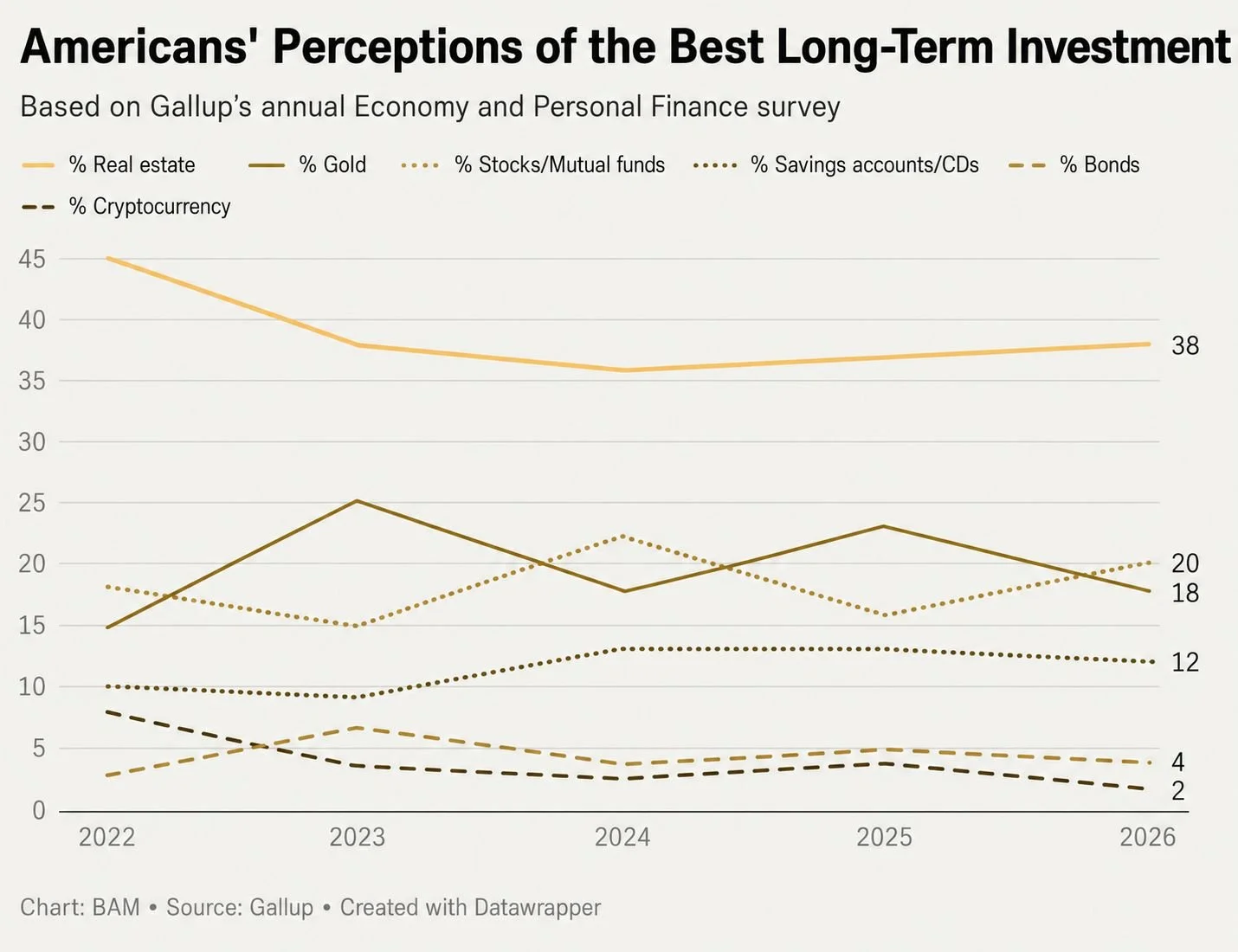
Real estate won again in 2026, for the 14th year running.
I get why people ask if that's still true. Crypto has its true believers, and while the stock market has had a rough stretch lately, it’s a popular option.
Here's what Americans actually said this year, and what a 14-year streak like this really tells you about where to put your money for the long haul.
What Americans Said in the 2026 Gallup Poll
Gallup asks the same question every year: which investment do you think is best over the long run? Here's how people answered in 2026:
Real estate: 38%
Stocks/mutual funds: 20%
Gold: 18%
Savings accounts/CDs: 12%
Bonds: 4%
Cryptocurrency: 2%
Real estate's lead is nearly double the next closest answer. Stocks climbed a bit since last year, up from 16% to 20%, and gold cooled off from its 2023 peak of 25%. Cryptocurrency, for all the attention it gets on social media, still can't crack 3%.
A 14-Year Streak, With Two Exceptions
I'll say this plainly: 14 years is a long time for anything to stay in first place. Real estate has topped this poll every single year since 2013, through a pandemic and a wave of interest rate hikes.
The streak has broken exactly twice.
2008 to 2009: During the financial crisis, savings accounts and CDs edged out real estate, 31% to 26% in September 2008 and 34% to 33% in April 2009.
2011 to 2012: Gold took the top spot for two years running, 34% to 19% in 2011 and 28% to 20% in 2012, while people were still spooked from the crash.
Both times, real estate came right back. It reclaimed the lead in 2013 and hasn't let go since.
Why Real Estate Keeps Winning
Here's my take on why this keeps happening. A home is something you can actually touch and use. It's not a ticker symbol on an app. It's where someone raises kids and slowly builds equity.
It’s true that stocks have historically offered higher returns. From 1990 to April 2024, the S&P 500 surged by 1,325%, while the S&P CoreLogic Case-Shiller U.S. National Home Price Index rose by 308%.
However, stocks also come with higher volatility, while real estate typically provides more stable growth. Even during economic downturns, such as the Great Financial Crisis of 2008, real estate has shown resilience and recovery.
This is highlighted when you look back at U.S. home price growth by the decade:
Source: ResiClub
U.S. home price growth by decade:
1990s: +30.1%
2000s: +47.3%
2010s: +44.7%
2020-2024: +47.1%
Every decade, even during the 2000s, home price growth has increased by 30% or more.
Of course, buying a home is a long-term investment. If you plan to move in a few years, it may not be the best fit.
While poll results show that Americans prefer real estate as a long-term investment, there is no one-size-fits-all answer. Always consult with your financial advisor when planning to invest for your future, as the best option depends on your financial goals, risk tolerance, and investment timeline.

53% of Americans Now Prefer Buying Over Renting. Here's What That Means for You
Bank of America's 2026 survey shows 53% of Americans now prefer buying over renting. Here's what it means for you.
For the first time since 2023, more Americans say buying beats renting.
That’s the headline stat from Bank of America’s 2026 Homebuyer Insights report. Based on responses to their national online survey, 53% of respondents say it’s better to buy a home in the current market than to rent or move in with family (47%).
Aside from that, other stats from the survey reveal some interesting trends, including improved levels of optimism around buying a home, despite ongoing affordability challenges.
Read on to see why and how this impacts you as a buyer or seller in [Your Market].
How Americans Feel About Homeownership Right Now
According to the methodology details for Bank of America’s 2026 survey, respondents are adults 18 years of age or older who “make or share in household financial decisions, and who currently own a home/previously owned a home or plan to own a home in the future.”
Of the 2,000 respondents in BofA’s survey:
1,000 are homeowners
1,000 are renters who have either owned homes previously or plan to own a home
The resulting data is compared to last year’s survey results, showing an overall improvement in consumer sentiment on homeownership and homebuying conditions:
90% say a home is a valuable investment (up from 79%);
94% say it provides stability (up from 83%);
87% say it feels like a milestone (up from 78%);
86% say it brings emotional fulfillment (up from 75%)
Beyond the abstract numbers, the data provides a signal of where consumer sentiment is heading, at least on a national level. But without the breakdown by respondent type (owners and renters separately), it’s unclear what percentage of renters are feeling better about their homebuying prospects this year compared to last.
Fewer Buyers Are Waiting for the Perfect Moment
Plenty of homebuyers in 2026 are still holding out for lower home prices and lower mortgage rates, but that share has dropped from 75% in 2025 to 71% in 2026.
Gen Z and Millennial buyers are especially motivated to buy, driving this year’s shift toward action:
Gen Z (68% are holding out in 2026 vs. 74% in 2025)
Millennial (70% holding out in 2026 vs. 77% in 2025)
As for Gen Z, survey data highlighted three specific ways they’re adapting to today’s market:
28% are taking on extra jobs
32% are considering co-buying with friends or family
31% are planning to leverage down payment assistance programs
Data comparing 2026 to the previous couple years is also showing an increased willingness to move across all three well-known compromise scenarios:
A more affordable area: 76% in 2026 vs. 71% in 2025 and 68% in 2024
Their dream home becoming available: 75% in 2026 vs. 69% in 2025 and 67% in 2024
A better location: 71% in 2026 vs. 65% in 2025 and 63% in 2024
Also, 52% of the homeowners in BofA’s survey say they expect to buy again, while 22% plan to move within the next year (up from 15% in 2025).
Why Affordability Is Still the Biggest Hurdle
Bank of America’s data for 2026 showed a year-over-year increase in survey respondents citing affordability constraints as an obstacle to homeownership:
58% cited expensive home prices as a top barrier, up from 46% in 2025
47% cited high interest rates, up from 40% in 2025
Based on their responses, renters are also trading down to cut housing costs.
For some, that means moving to a more affordable rental complex. For others, it could mean moving to a unit with fewer bedrooms. In some markets, a drop from a two-bedroom to a one-bedroom unit can save a renter around $200 a month.
What This Means If You're Thinking About Buying or Selling
The biggest takeaway from Bank of America's survey isn't that the market suddenly became easy. Affordability is still a challenge, and mortgage rates remain higher than many buyers would like.
What's changing is consumer mindset.
After several years of waiting for the "perfect" time to buy, more Americans appear to be accepting that today's market may simply be the market they'll have to navigate. Instead of waiting indefinitely, many are adjusting their expectations, exploring different neighborhoods, considering smaller homes, or taking advantage of down payment assistance programs.
That's an important shift because housing markets don't move based only on prices and interest rates. They also move based on confidence. When more buyers decide they can make today's conditions work, activity tends to follow.
National surveys can only tell part of the story, and every local market behaves differently. But they do offer a useful glimpse into how consumers are thinking. Right now, that thinking seems to be moving away from waiting for perfect conditions and toward finding opportunities within the market that exists today.
Stafford & Rebecca | Compass Real Estate Atlanta

43% of Homeowners Are Equity Rich. Are You One of Them?
New data shows nearly half of all mortgaged homes in the U.S. are equity rich. If you own a home in Atlanta here's what that means for your options.
If you own a home in Metro Atlanta, there's a good chance you're sitting on more equity than you realize.
New data shows 43.3% of mortgaged homes across the country are equity-rich right now.
At the same time, a separate survey from Point found that 48% of homeowners say they aren't planning to move this year, but not for the reasons you may think.
A lot of them assume they're stuck, mostly because of where mortgage rates are sitting. But being equity-rich changes the calculation in ways most people haven't thought through yet.
So, today, I’m breaking down what the data actually shows, why so many homeowners feel locked in place, and what your equity could actually mean for your options.
What Does "Equity Rich" Actually Mean?
"Equity-rich" is a specific term used in real estate. It means you owe less than 50% of what your home is currently worth.
So if your home is worth $400,000 and your remaining mortgage balance is $180,000, you're equity-rich. You have more than half the home's value sitting on your side of the ledger.
Equity-rich means you don't just have equity in your home. It means you have a lot of it, enough to give you real financial options you may not have considered.
What the Numbers Show
Why So Many Homeowners Feel Stuck
If you locked in a mortgage rate at 3% a few years ago, the idea of selling and buying again probably doesn't sound appealing.
With 30-year rates currently sitting at 6.42% and no Fed cuts expected until late 2027, trading your current payment for one that's nearly double is a hard sell. No one would blame you for hesitating.
After all, a recent survey from Point found 48% of homeowners (nearly half) say they aren't planning to move this year, with rate lock-in and general uncertainty cited as the main reasons.
What that rate calculation doesn't account for, though, is how much equity you have, and how much that could save you each month on your next mortgage payment.
How Your Equity Changes the Math
When you're equity-rich, you're not approaching your next purchase the same way you did the first time.
A larger equity position means a larger down payment, which means a smaller loan, which means your monthly payment on a higher-rate mortgage may not be as painful as you'd expect.
Depending on how much equity you've built, you may have more options than you think:
Put a significantly larger down payment on your next home, reducing the loan amount and softening the rate impact
Use a HELOC to access equity without selling
Sell, then rent temporarily while you wait for rates or prices to shift
Buy your next home outright, with no mortgage at all
Most homeowners run the math on today's rates without accounting for what their equity actually does to that number. The monthly payment picture looks very different when you're bringing 50% or more to the table.
What This Could Mean for You
The bigger takeaway here is this: A lot of homeowners are making decisions based on the market from 2-3 years ago, not the market we’re actually in today.
Yes, rates are higher.
But home values are also dramatically different, and for many homeowners, the amount of equity they’ve built changes the conversation more than they realize.
You may still decide staying put is the right move. A lot of people are. But it’s worth understanding your position before assuming you don’t have options.
Because the homeowners making the best decisions right now aren’t guessing. They know their numbers. ATTOM’s Q1 2026 report shows 43.3% of mortgaged U.S. homes are equity-rich, meaning owners owe no more than half of what their home is worth. Georgia is slightly below the national figure at 41.9%, down from 44.0% last quarter and 43.7% a year ago. Atlanta’s market is also shifting: April 2026 data showed pending sales down year over year, while median sales price rose to $417,000, which points to a more selective market rather than a collapsed one.
Atlanta homeowners are still sitting on real equity.
ATTOM’s Q1 2026 report shows that 41.9% of mortgaged homes in Georgia are considered “equity rich,” meaning the owner owes less than half of what the home is worth.
Nationally, that number is 43.3% — the lowest level since late 2021, but still a powerful reminder of how much wealth homeowners have built over the last several years.
Here’s why that matters in Atlanta:
Many sellers have options.
Many buyers are waiting for the right home.
And the homes that are well-prepared, well-priced, and well-positioned are still the ones creating movement.
This is not the 2021 market. It is also not a market to sit out if your move would improve your life.
Equity gives sellers leverage. More inventory gives buyers opportunity. And strategy matters more than ever on both sides.
If you’re wondering what your home is really worth in today’s Atlanta market — or how much equity you may have to work with — message me. This is exactly the kind of conversation worth having before you make your next move.