
The 4 D's of Getting Your Home Ready to List
Thinking about listing your Atlanta home in the next few months? Learn the 4 D's Team Stafford & Rebecca walk every seller through before hitting the market: Declutter, Depersonalize, Deep Clean, and Don't Ignore Deferred Maintenance.
If you're reading this, there's a decent chance you're not quite ready to call an agent yet, but you're circling the idea. Maybe you're picturing a "For Sale" sign in the yard sometime in the next 90 days. Maybe you've already started opening closets you haven't touched in years and wondering where to even begin.
That in between stage, where you know you want to sell but haven't started prepping, is exactly where we spend most of our time with sellers. It's also the stage where the right plan saves you the most money and the most stress. At Team Stafford & Rebecca, we've walked hundreds of Atlanta homeowners through this exact process, and it almost always comes down to the same four things. We call them the 4 D's: Declutter, Depersonalize, Deep Clean, and Don't Ignore Deferred Maintenance.
None of these require a full renovation. What they require is a plan and someone who can tell you honestly where to spend your time and money, and where not to.
Declutter
Buyers aren't just looking at your home, they're trying to imagine their life inside it. A room full of furniture, papers, and everyday clutter makes that harder. It also makes the space look smaller than it is, which affects how buyers value it before they've even seen the square footage.
You don't need to empty the house. You need to edit it.
Clear countertops in the kitchen and bathrooms down to a few intentional items
Remove at least one piece of furniture from any room that feels tight or crowded
Box up out of season clothing, extra linens, and anything you haven't used in the last year
Clear closets to roughly half full so they photograph and show as storage, not overflow
A good rule: if you're on the fence about whether something needs to go, it needs to go, at least for now. You can always bring it back after closing.
Depersonalize
This one surprises people, because it feels counterintuitive. Your home is full of photos, memorabilia, and personal touches because it's your home. But a buyer walking through needs to picture their own family there, not yours.
Family photos, personal collections, and strongly personal decor can make it harder for a buyer to mentally move in. This isn't about erasing your personality from the house. It's about creating a space that reads as a home rather than as someone else's home.
Pack away family photos and personal memorabilia before your first showing
Tone down highly specific decor choices, like sports team shrines or very bold paint colors, in favor of something more neutral
Keep a few warm, lived in touches, like fresh flowers or a well placed throw blanket, so the home still feels inviting rather than sterile
Deep Clean
This is the one people underestimate the most. A home that's tidy but not deeply clean still sends a signal to buyers, and it's usually the wrong one. Grimy grout, dusty baseboards, and a hazy oven door read as neglect, even if the home has been genuinely well cared for.
A professional deep clean before listing photos are taken is one of the highest return, lowest cost things you can do.
Have carpets professionally cleaned, especially in high traffic areas
Clean windows inside and out so natural light photographs well
Pay attention to the details buyers notice up close: baseboards, light switch plates, ceiling fans, and grout
Don't skip the garage, basement, or laundry room. Buyers open those doors too
Don't Ignore Deferred Maintenance
This is the D that costs sellers the most when it's skipped. Deferred maintenance means the small repairs that got pushed off: a dripping faucet, a cracked light fixture, a door that sticks, a stain on the ceiling from a leak that was fixed years ago but never repainted.
Buyers, and their inspectors, notice these things. A house with several small, visible issues can make a buyer wonder what else hasn't been maintained, even when the answer is nothing. That doubt often shows up later as a lower offer or a long list of repair requests after inspection.
Walk through your home room by room and make a list of anything that's broken, sticking, leaking, or stained
Prioritize items that are cheap to fix but highly visible: leaky faucets, burnt out bulbs, loose cabinet hardware, scuffed paint
Get ahead of bigger ticket items, like an aging water heater or a roof nearing the end of its life, so they don't become a surprise during a buyer's inspection
When in doubt, ask us. Not every repair is worth making before you list, and we'll tell you honestly which ones matter and which ones don't
How much time does this actually take
Most Atlanta sellers we work with start this process somewhere between 60 and 90 days before they want to list, which is exactly why we're glad you're thinking about it now rather than the week before you want a sign in the yard. Some homes need far less time. Others, especially ones with deferred maintenance that's been building for a while, benefit from starting earlier. The honest answer is that it depends on your home, and that's exactly the kind of thing worth a conversation before you start any of it.
Frequently asked questions
What should I fix before listing my house? Focus on anything visible, unsafe, or likely to be flagged by a buyer's inspector: leaks, electrical issues, and anything affecting the roof, HVAC, or foundation. Cosmetic fixes like paint and fixture updates are usually worth doing. Larger renovations often aren't worth the investment right before a sale. The right answer depends on your home and your market, which is why we walk every seller through this individually.
How long does it take to get a house ready to sell? It depends on the home's condition, but most sellers benefit from 60 to 90 days of lead time. A home in strong condition might need only a few weeks. One with deferred maintenance or a lot to declutter may need longer.
Do I need to repaint before I sell? Not always, but a fresh coat of neutral paint in high traffic rooms is one of the more affordable ways to make a home feel newer and larger in photos and in person.
Is it worth getting a pre listing inspection? For many Atlanta sellers, yes. It lets you address issues on your own terms and timeline instead of having them surface during a buyer's inspection, where they can slow down or derail a deal.
Should I declutter before or after professional photos? Always before. Photos are often a buyer's first impression of your home, and a cluttered or overly personal space photographs poorly no matter how good the home itself is.
Can I use AI to figure out what to fix before I sell? It can be a useful starting point. Tools like ChatGPT and Gemini are good at helping you organize a checklist or think through general priorities. What they don't have is live Atlanta MLS data, so they can't tell you what buyers in your specific neighborhood are actually responding to right now, or what a repair is really worth in your price range. Use AI to help you think, then bring it to us before you spend money. That's exactly the kind of thing worth a quick conversation rather than a guess.
Ready to talk through your own timeline?
Every home is different, and the right prep plan for yours depends on its condition, your timeline, and what buyers in your specific neighborhood are looking for right now. If you're thinking about listing sometime in the next few months, we'd rather walk your home with you now than have you guess your way through it alone.
Reach out to Team Stafford & Rebecca for a free pre listing walkthrough. We'll give you an honest, room by room plan for what to do, what to skip, and when to list.
Stafford Weber | Rebecca Kubin | Compass Real Estate
Is Real Estate Still the #1 Long-Term Investment in 2026? Survey Says Yes!
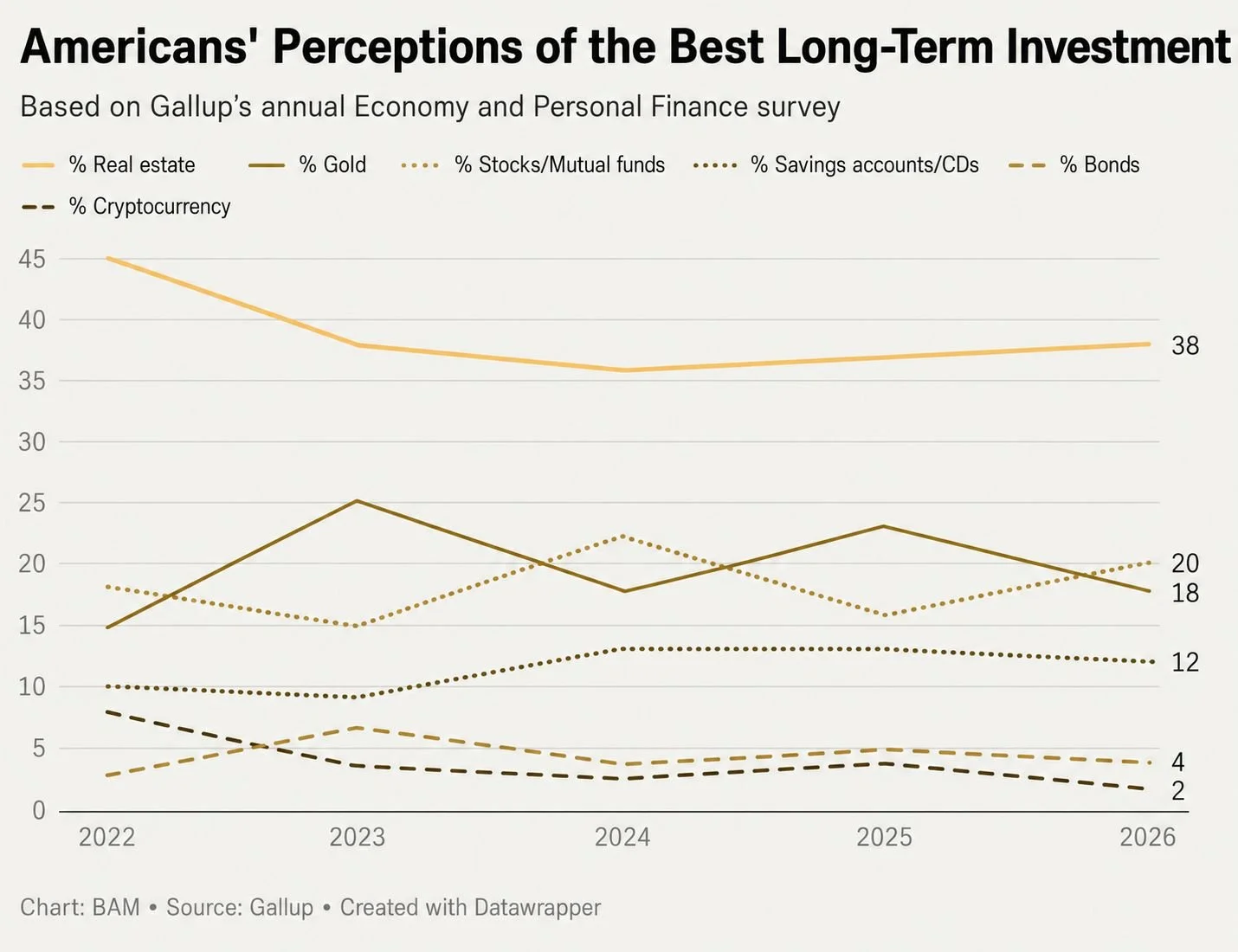
New Gallup data shows real estate remains Americans' top pick for the best long-term investment in 2026, ahead of stocks, gold and crypto. Here's what that means for Atlanta.
Every year, Gallup asks Americans a simple question:
What's the best long-term investment?
Real estate won again in 2026, for the 14th year running.
I get why people ask if that's still true. Crypto has its true believers, and while the stock market has had a rough stretch lately, it’s a popular option.
Here's what Americans actually said this year, and what a 14-year streak like this really tells you about where to put your money for the long haul.
What Americans Said in the 2026 Gallup Poll
Gallup asks the same question every year: which investment do you think is best over the long run? Here's how people answered in 2026:
Real estate: 38%
Stocks/mutual funds: 20%
Gold: 18%
Savings accounts/CDs: 12%
Bonds: 4%
Cryptocurrency: 2%
Real estate's lead is nearly double the next closest answer. Stocks climbed a bit since last year, up from 16% to 20%, and gold cooled off from its 2023 peak of 25%. Cryptocurrency, for all the attention it gets on social media, still can't crack 3%.
A 14-Year Streak, With Two Exceptions
I'll say this plainly: 14 years is a long time for anything to stay in first place. Real estate has topped this poll every single year since 2013, through a pandemic and a wave of interest rate hikes.
The streak has broken exactly twice.
2008 to 2009: During the financial crisis, savings accounts and CDs edged out real estate, 31% to 26% in September 2008 and 34% to 33% in April 2009.
2011 to 2012: Gold took the top spot for two years running, 34% to 19% in 2011 and 28% to 20% in 2012, while people were still spooked from the crash.
Both times, real estate came right back. It reclaimed the lead in 2013 and hasn't let go since.
Why Real Estate Keeps Winning
Here's my take on why this keeps happening. A home is something you can actually touch and use. It's not a ticker symbol on an app. It's where someone raises kids and slowly builds equity.
It’s true that stocks have historically offered higher returns. From 1990 to April 2024, the S&P 500 surged by 1,325%, while the S&P CoreLogic Case-Shiller U.S. National Home Price Index rose by 308%.
However, stocks also come with higher volatility, while real estate typically provides more stable growth. Even during economic downturns, such as the Great Financial Crisis of 2008, real estate has shown resilience and recovery.
This is highlighted when you look back at U.S. home price growth by the decade:
Source: ResiClub
U.S. home price growth by decade:
1990s: +30.1%
2000s: +47.3%
2010s: +44.7%
2020-2024: +47.1%
Every decade, even during the 2000s, home price growth has increased by 30% or more.
Of course, buying a home is a long-term investment. If you plan to move in a few years, it may not be the best fit.
While poll results show that Americans prefer real estate as a long-term investment, there is no one-size-fits-all answer. Always consult with your financial advisor when planning to invest for your future, as the best option depends on your financial goals, risk tolerance, and investment timeline.